
Manual Sardius Stream Set Up
Updated
A Manual Sardius Stream is used when you are sending a live video feed to Sardius using:
-
RTMP or RTMPS
-
SRT
This option is ideal when:
-
You are using a software encoder (OBS, vMix, Wirecast, etc.)
-
You are manually configuring a hardware encoder or PTZ Camera
-
You need direct access to stream URLs and keys
Set Up a Manual Stream
Enable Streaming for Your Channel
To create default stream settings, you must first enable streaming on your Sardius Channel.
To do this, select "Stream" from the Channel sidebar navigation and click Enable Streaming!
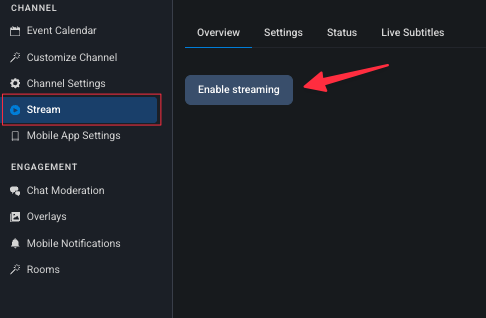
Your Sardius Channel will be updated in the background and prepared for streaming. This process takes only a couple of seconds, so do not leave or refresh the page. Once it is ready, you will be prompted to set up your default settings.
Next, in the same stream settings tab - click Set up
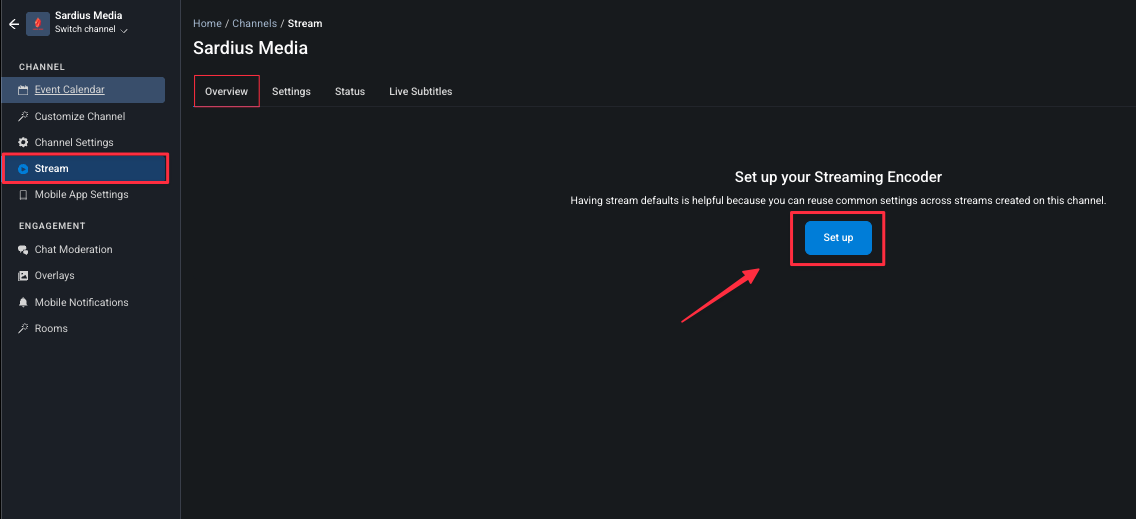
When creating a Manual stream, you will need to complete four steps. Each step must be completed in order before moving on.
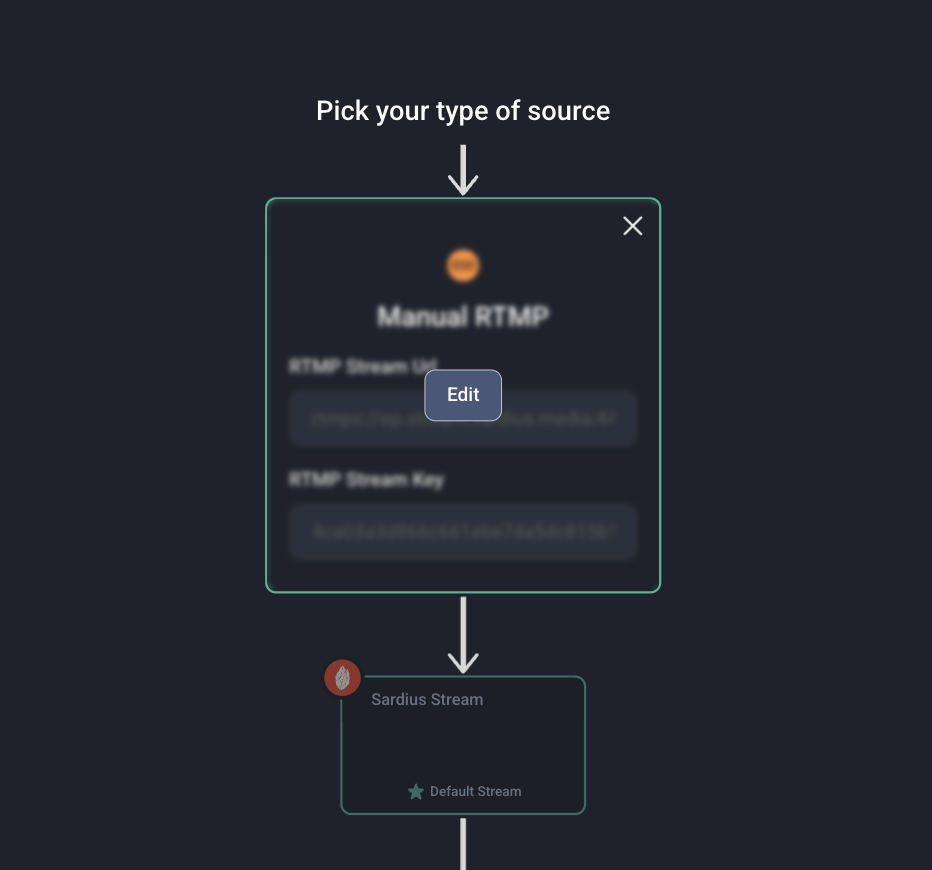
- Choose Manual Source – Select how your stream is being sent to Sardius
-
Pick Your Protocol – Choose between RTMP or SRT based on what your encoder supports
-
Add Outputs (as needed) – Choose where your stream will be delivered. You can add one or multiple outputs, such as:
-
Facebook
-
YouTube
-
Custom RTMP destinations
- Add your Stream URL and Stream Key –
-
Copy the Stream URL and Stream Key (you must save your stream settings first in order to copy these)
-
Paste them into your encoder’s streaming settings (RTMP, or SRT, depending on your protocol)
-
Keep your Stream Key private — it should not be shared publicly
You do not upload video here. This step simply provides the connection details your encoder will use when you start streaming.
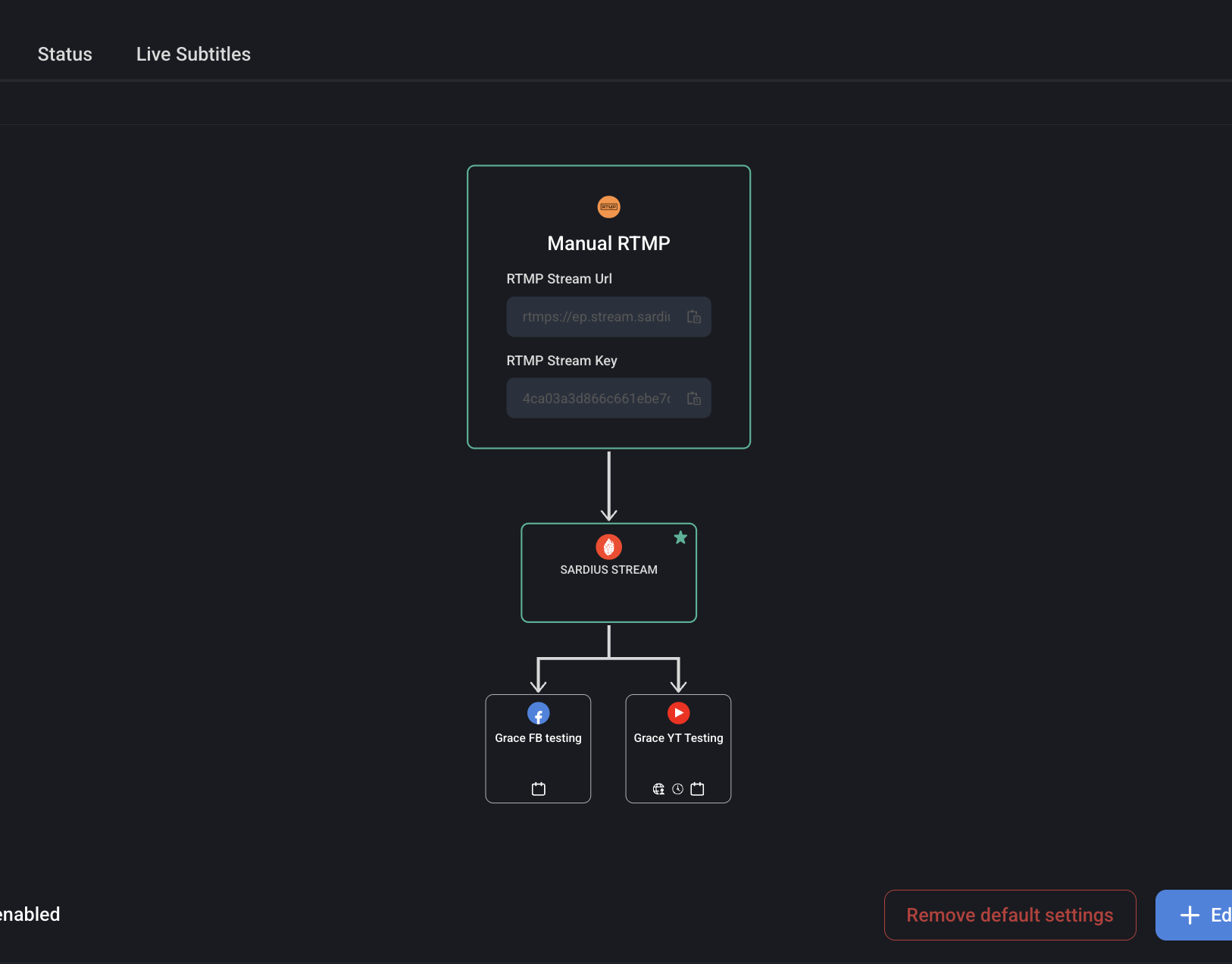
Here is an example of a manual stream configuration that has gone through these steps:
After Setup: Sending Your Stream to the Channel
As mentioned in step 4, after completing and saving your configuration:
-
Copy the provided stream URL and stream key
-
If you will be using SRT, please reference the Parse SRT URL instructions below.
-
Paste the information into your encoder software or hardware
-
Start streaming from your encoder
Your stream will begin delivering video to the Sardius channel.
Parse SRT URL
In many cases, the full SRT URL provided by Sardius cannot be pasted into a single field in your encoder.
Different encoders handle SRT settings differently:
-
Some require the destination address and port to be entered separately
-
Some require the passphrase to be entered in a dedicated field
-
Some encoders do not use the Stream ID at all
Because of this, you may need to break the SRT URL into individual components before entering it into your encoder.
URL breakdown example:
srt://{URL}:{PORT}?passphrase={KEY}&streamid={STREAM ID}
Our example:
srt://ep.stream.sardius.media:778?passphrase=1fdb497c5f8ec88ec9898c22a026ce14k7f50d77bad9201e8b85ebf9d1b2e86a7&streamid=7f50d77bad9201e8b85ebf9d1b2e86a7
From our example, we have:
- URL: ep.stream.sardius.media
- Port: 778
- Key: 1fdb497c5f8ec88ec9898c22a026ce14k7f50d77bad9201e8b85ebf9d1b2e86a7
- Stream ID: 7f50d77bad9201e8b85ebf9d1b2e86a7
Encoder Configuration
Using the URL, Key, and other information provided, set up your encoder's configuration accordingly.
Be sure to follow our Recommended Encoder Settings for your device to ensure maximum compatibility with our system.
When complete, save your configuration. Start your encoder to begin streaming to the Sardius Control Panel.
Verify the Connection
Once your encoder is streaming:
-
Return to the Sardius Control Panel
-
Create or open a Live Event on your calendar
-
Launch the Live Event Manager
If the encoder is connected successfully, you should see live video appear in the player.
Seeing video confirms that your encoder is properly connected to your Sardius channel.
Common Questions & Troubleshooting
Why can’t I continue to the next step?
- Each step in the Stream Stepper must be completed before proceeding
Can I edit a Manual stream later?
- Yes. You can edit the source, encoder, input, and outputs before the stream goes live
I don’t see video in the Sardius player. What should I check first?
Start with these basics:
-
Confirm your encoder is actively streaming (not just configured)
-
If you are using RTMP or RTMPS, double-check that the Stream URL and Stream Key were entered correctly.
-
If you are using SRT, double-check that the Stream URL, Port, and Passphrase were entered correctly
-
Make sure your encoder started streaming before the event start time
-
Refresh the Live Event Manager after the encoder is live
If all of the above are correct and you still don’t see video, reach out to our team for support!
What's the difference between Sardius Stream and Entrypoint?
-
Sardius Stream uses RTMP, RTMPS, and SRT and is more efficient for pairing with Social Media. Sardius Stream does not support 4K resolution, only HD.
-
Entrypoint is similar to Sardius Stream but utilizes HLS instead of RTMP/RTMPS/SRT to insert into Sardius’s Content Delivery Network (CDN). Because your stream is natively in HLS, no transcoding is required to deliver your content to your users using mobile devices. This solution is ideal for clients using HLS as their source protocol. Sardius HLS Entrypoint allows for HLS output to a Sardius Channel, and also most web and mobile apps.